
No eligible citizen is left out while no ineligible person is included in the electoral roll.
On October 27, Karnataka’s Chief Electoral Officer released the final electoral roll for the Special Intensive Revision . This is the 8th such revision of voter rolls to happen in India but is distinct because all eight earlier revisions of this kind grew the electorate, and this has been the first to shrink it , for reasons the Election Commission has not been consistent about. Every page of the CEO’s summary booklet carries the same footer: “No eligible citizen is left out while no ineligible person is included in the electoral roll.”
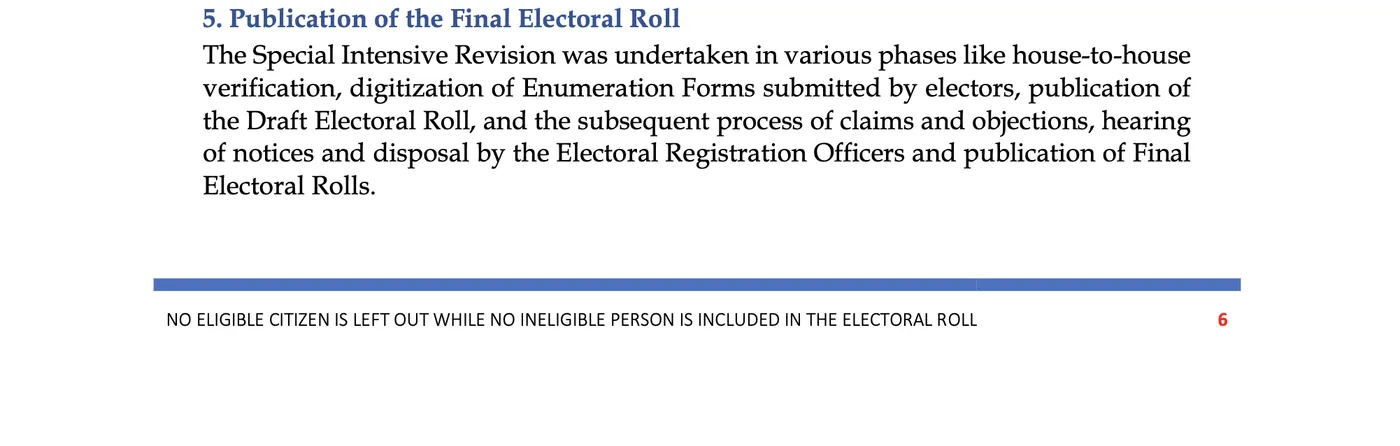
That is a reassuring claim. Since it is also absolute, a single contradictory example should be enough to fail it.
Problems with the SIR have been reported so widely across the country that each new one arrives with the air of “well, no surprises there.” Bihar had identical duplicate voters and the living declared dead, and Bengal had voters on the 2002 roll who were told they weren’t. Karnataka has had twins flagged as a “logical discrepancy”, people marked “shifted” who never moved and deletions with no reason given.
I did everything I was supposed to do, and they still marked me as shifted.
Two days after the final roll went up, I published a 45 million row dataset processed from 60,923 PDFs. The public version is anonymized, but I still maintain a complete dataset for further research. So when The Hindu found nonsense names in the roll (such as µ¢µÌèÌ, “Husband Husband”, a father called r•••••••••••@gmail.com), I knew I must dig deeper to see what the scope of the problem was.
My dataset could not answer the question alone. As its published documentation says, its numbers cover only this latest version of the SIR. It shows that about deletions took place, while the headline number most people know says Karnataka’s voter list is people shorter than it was in June. This gap exists because voters (people who could vote in the 2024 general election) were left out of the draft roll when it was first released. They were removed and then given a chance to file “claims” and reapply. During this “Claims and Objections” period, the Election Commission added names, which includes new voters and people who had moved, and made the deletions that my dataset shows.
To reach the headline number independently, I needed the rolls from before the revision. The folks at Mathakaavalu and Edellu Karnataka had digitized them and were willing to collaborate on this exercise. Their efforts gave me the 2002 roll that everyone was supposed to be matched against, the electoral roll as it stood in January 2025, the draft roll for the 2026 SIR, and the first list of the people removed before the draft, along with the reason for each person. With all of these you can follow one person from 2002 to the end of October and see what happened to them.
So I joined these rolls by voter ID (the EPIC number) and tested each half of the slogan. Neither half is completely true. I found duplicates, voters declared dead who filed an objection to the news, nonsense names, notices spread very unevenly across constituencies supposedly working under the same rules, and more. I will show examples of each and link to the original PDFs where I can, but for the counts I am publishing only aggregates.
I went through this process myself, and travelled 300 km for a hearing that did not happen because the rules had been changed halfway due to the protests regarding it in Delhi. Rules have been changed plenty of times during the course of this exercise, making the process quite stress-inducing. I had my documents, the time to travel, and an upper-class, educated, majority identity household behind me; many people do not.
In case you’re short on time and just want your SIR numbers to-go, here’s the TL;DR.
| No ineligible person is included | Count |
|---|---|
| People on the roll more than once in their own booth | 8,992 |
| Voter IDs on the roll in two constituencies | 461 |
| House numbers with 100 or more voters | 381 |
| Voters with no real house number | 20.7 lakh |
| Names printed as symbols | 1,318 |
| Pairs of voters who are each other's father | 296 |
| No eligible citizen is left out | Count |
|---|---|
| Voters struck off before the draft roll | 1.05 crore |
| Of those, back on the final roll | 14,900 |
| Told they are not on the 2002 roll, though they are | 3,115 |
| Struck off after a notice under the nine-month rule | 4,954 |
| Marked dead, and back on the final roll | 332 |
| New voters holding a removed voter's ID | 234 |
Bommanahalli lost 53% of its voters
Four measures of the revision across 224 assembly constituencies, January 2025 to October 2026
The rest of this piece shows the evidence for each. For no reason other than whimsy (and to encourage the consumption of long-form content), the sections are named after films.
No ineligible person is included
Who is an ineligible person? It sounds like an existential question, but let us try to attempt answering it in a tangible way.
Hum Paanch We Five

This is from the list of people added to the roll in Shorapur during the revision. Gousiya Begam, 18, appears five times on one page, identical in name, father, house number, age and sex, each time with a different voter ID. Further down the same page, Abdul Rahiman and Shankarnag, both also 18, each appear twice.
This is not confined to Shorapur. During the revision, 762 duplicate voters were deleted and 8,268 new duplicates were added, about eleven new duplicates for each one removed.
At least 8,992 people now show up more than once in their own polling booth, with the same name, relative’s name, age and sex each time. Between them they have 18,271 voter cards, each with a different ID.
The revision added 11 duplicates for every one it removed
Duplicate entries removed and added during the revision, Karnataka, final roll, October 2026
at least 8,992 people on the roll more than once in their own booth
Duplicate
In theory, your voter ID is unique and yours for life. When you move, you file a Form 8 and your old entry gets deleted. Sometimes, SIR or no SIR, that does not happen.
TDB1993
- Final roll, Bagalkot
Final roll, Bagalkot
This is Sangappa, who is 33, on the roll in Bagalkot.
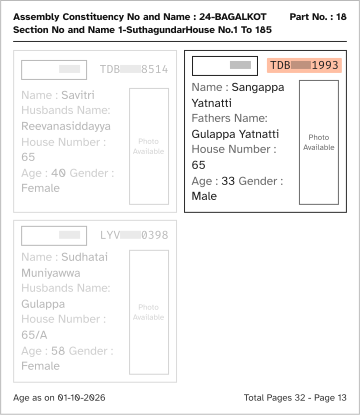
Final roll, Bagalkot part 18, page 13. - Final roll, Yeshwanthapura
Final roll, Yeshwanthapura
And this is Sangappa again, on the roll in Yeshwanthapura, 500 kilometres away, with the same voter ID.
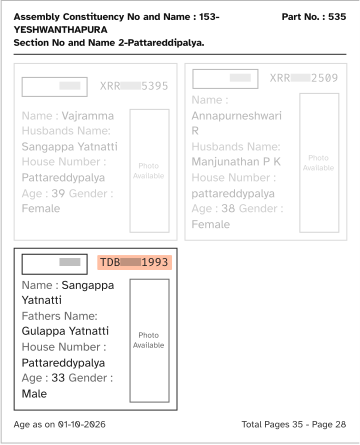
Final roll, Yeshwanthapura part 535, page 28.
At least 461 voter IDs appear in two constituencies at once just like him.
at least 461 voter IDs on the roll in two constituencies at once
Housefull

All thirty voters on this page reside at house number 396 in Kagwad, and so is everyone on the twenty-nine pages before and after it. I realize this is India; some houses are small, some houses are big. According to NFHS data, the average household in India has 4.4 people. Which makes this one one with 688 people, nearly three quarters of the booth, a massive outlier. They also have around 418 different fathers, husbands and mothers between them. Relevant Chup Chup Ke Scene.
The Commission’s answer is that these are “notional numbers”. That may be so. But the enumeration phase of this revision was a house-to-house visit, which dropped people because they were “permanently shifted” and as “absent”. How does an official establish that someone has left a house whose number is only ‘notional’?
House 396 is not alone. Karnataka has 381 house numbers that each have 100 or more voters naming 50 or more different relatives, with around 54,778 voters in all. Another voters still on the roll have a 0, a dash or nothing at all where the house number should be.
In one Tumkur City booth, 545 of the 663 voters have no usable house number, and for most of them the roll just says 0. How does a BLO knock on house number 0?

at least 20,73,689 voters still on the roll with no usable address
Gumnaam Nameless
A rose by any other name would smell just as sweet. What about a voter by any other name?
On this one page of the Raichur Rural roll, twenty of the thirty voters have strings of symbols where their name or their relative’s name should be. As a result, these people cannot be found on the Election Commission’s own search portal.

Raichur in particular has been affected by font issues. (If you are the Commission, the folks at Sanchaya have put together a whole library of Kannada fonts that work for next time!)
Half of all garbled names come from just four booths in Raichur Rural
Share of voters whose name or relative's name is printed as symbols, 12 booths with the most, Karnataka, final roll, October 2026
Garbled symbols aside, there are plenty of other oddly shaped names, like a relative named father or husband husband, a name that is a single letter, or a phone number where a mother’s name should be.
About 10,000 voters have something other than a name where a name should be
Entries printed in place of a voter's or relative's name, by kind, Karnataka, final roll, October 2026
at least 1,318 unreadable names
Hum Aapke Hain Koun Who Am I to You?
In the movie Paa, Amitabh Bachchan played Abhishek Bachchan’s son. The voter rolls suggest that this kind of an arrangement is more common than one would think.
The first card below belongs to Chanda Sab from Shorapur. His father is Allisab.

And on the very next card is Allisab, who is also 40 and lives in the same house and his father is Chanda Sab.
I found 296 pairs like this, where two voters were in one house, close in age, and each had the other’s name as their father. In 27 of those pairs, the two are the same age. In the case of Syed Mohammed Saleem and Shaik Naseem Banu in K.R. Pura, who are both 43 and live in the same house, he is a man, she is a woman, and each of them is the other’s father.

at least 296 pairs of voters who are each other's father
No eligible citizen is left out
From the end of June this year, BLOs went house to house handing out enumeration forms to voters. 1.08 crore people did not submit forms back, and they were struck off before the draft roll was published. Each was assigned a reason: Absent, Shifted, Dead, or Duplicate (and an “Other”, giving this the moniker the ASDDO list). If you were wrongly struck off, your hope was to file Form 6 during claims and objections and apply again, as a brand new voter.
I wanted to know how many of those people made it back. I found of the ASDDO voters in the January 2025 roll and looked for each of them among the people added to the final roll in the same constituency with the same name, relative and age. Nobody is supposed to come back under their old voter ID as because reapplying gets you a new one. About 2,300 of them are on another constituency’s roll under their old ID, which suggests they had moved, so I have not counted them as coming ‘back’.
One in five voters was struck off before the draft roll
Voters on the roll in June 2026, and those struck off before the draft roll by reason, Karnataka
About 14,900 people were added back, which is 0.14%. Of the people aged 75 and above who were struck off, only 206 came back.
For every 708 people struck off, only one came back
People struck off before the draft roll by the reason given, and those added back on the final roll, Karnataka
64.0 lakh marked permanently shifted 9,902 added back
18.5 lakh marked absent 4,035 added back
16.3 lakh marked dead 332 added back
6.7 lakh marked already enrolled elsewhere 623 added back
There are two ways to understand this. Either the BLOs were incredibly accurate, and 99.86% of a crore of people really had died, moved or were duplicates. Or most people who were wrongly struck off never found out, or found out and could not do anything about it. Aroon Deep offers a third reading, that a lot of the voters who didn’t come back were only ever on the roll because a BLO once enrolled them sometime in their lives, that they anyway vote rarely, and that the revision is counting on them not caring enough to reapply.
14,900 of 1.05 crore struck offback on the final roll
Main Hoon Na I'm Here, Aren't I?
The premise of the SIR was that if you could find yourself or your parent in the 2002-03 roll, you were in. If you could not be found, you got a notice saying you were “Unmapped with Last SIR”, and then you had to go to a hearing with documents and prove that you exist.
But some of the people who got this notice are in the Chief Electoral Officer’s own published CSV of the 2002 roll under the exact same voter ID. Hoblamma, 95 years old, is one of them.
MZS2292
- 2002 roll
2002 roll
Here is Hoblamma in the CEO’s own 2002 roll, aged 69, under the voter ID she still holds today.

CEO's 2002 roll, constituency 31, part 79. - Notice list
Notice list
Twenty-four years later, the notice list for her booth in Siraguppa tells her she is “Unmapped with Last SIR”.
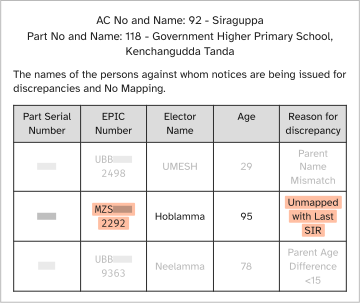
Notice list, Siraguppa part 118, page 5. - Final roll27 Oct 2026
Final roll27 Oct 2026
And here she is in the final roll, deleted.
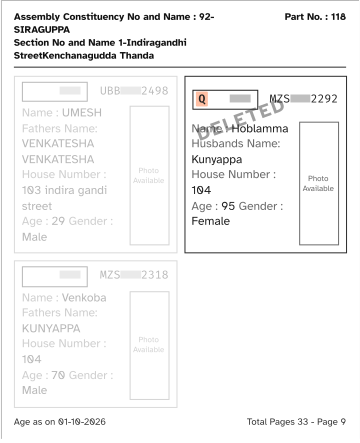
Final roll, Siraguppa part 118, page 9.
No explanation for the failed mapping has been given even in other states.
3,115 voters like her were told they could not be matched to the 2002 roll even though their voter ID, name and age all match the CEO’s copy of it analyzed by me.
at least 3,115 told they are not on the 2002 roll even though they are
Judwaa Twins
The notices also list out the Commission’s “logical discrepancy” reasons , which are worth reading because they tell you what government software thinks a normal human family looks like. We encounter conditions like Parent Age Difference <15, Parent Age difference >50, Grandparent Age difference <40, Progeny >= 6, and my favourite, Progeny Age Gap <9 Month. That last one means two children of one parent can’t be born less than nine months apart, which is true unless they’re twins.
The nine-month rule was the most likely to get a voter struck off
Notices of voter disqualification in Karnataka between August and October 2026, categorized by reason
| Reason on the notice | Notices | Struck off | Voters |
|---|---|---|---|
| Not found on the 2002 rollUnmapped with Last SIR | 23.4 lakh | 1.7% | 39,337 |
| Name differs from the 2002 entrySelf Name Mismatch | 5.3 lakh | 0.7% | 3,485 |
| Parent under 15 years olderParent Age Difference <15 | 3.9 lakh | 1.0% | 3,891 |
| Parent's name differs from 2002Parent Name Mismatch | 3.3 lakh | 0.9% | 2,941 |
| Grandparent under 40 years olderGrandparent Age difference <40 | 2.6 lakh | 1.2% | 3,179 |
| Sibling born within 9 monthsProgeny Age Gap <9 Month | 1.7 lakh | 2.2% | 3,735 |
| Parent over 50 years olderParent Age difference >50 | 78,934 | 0.9% | 682 |
| 6 or more children of one parentProgeny >= 6 | 76,846 | 0.7% | 562 |
My son and daughter are twins, but there are no documents that say so.
In Chintamani, a brother and a sister, both 36, with the same father and the same house, were each sent a notice for being born less than nine months apart.

In the final rolls, the sister has been struck off as disqualified while her brother is still a voter.

This is a known defect in the system and has been reported elsewhere in the country too.
In Karnataka, at least 4,954 people were flagged under the nine-month rule and struck off as disqualified, and for 3,735 of them it was the only reason given. One can also imagine that not all of them will be twins, since the rule would also catch mis-entered ages and wrongly linked parents.
at least 4,954 struck off after a notice under the nine-month rule
Pehchan Identity
One of the issues with my phone number is that it used to belong to someone else. To this day, when I make payments via UPI, sometimes the sender details show up as Nethravati (my nickname with some of my friends is Neetu because of this).
A voter ID is supposed to be different and is yours for life. In Dasarahalli, in Bengaluru, it appears to work more like my phone number, with consequences more serious than being called Neetu.
XMK7019
- January 2025 roll
January 2025 roll
This is Shivananjamma, who is 80, on the roll in January 2025, with her voter ID.
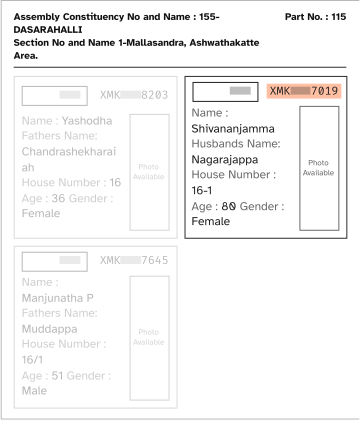
January 2025 roll, Dasarahalli part 115, page 7. Via Mathakaavalu. - ASDDO list
ASDDO list
By the time her BLO drew up the ASDDO list for her booth, she had been marked dead.
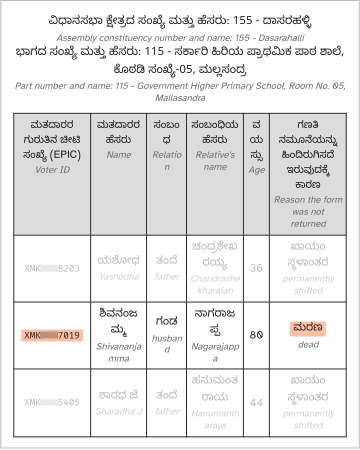
ASDDO list, Dasarahalli part 115, page 6. Kannada, translated in italics. - Final roll27 Oct 2026
Final roll27 Oct 2026
New voter Vaibhav, 19, was added to the Dasarahalli roll and assigned her exact same voter ID.
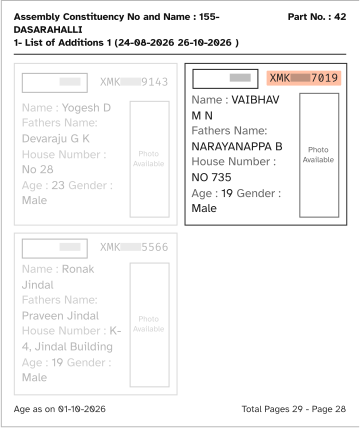
Final roll, Dasarahalli part 42, page 28, list of additions.
I found at least 234 new voters in Dasarahalli whose voter ID belonged, in January 2025, to a different person who was then struck off before the draft roll. Most of those people were marked as shifted or absent, and around ten of them, like Shivananjamma, are marked dead.
234 new voters in Dasarahalli were given a voter ID that belonged to someone else
Voter IDs held by two different people, by how the earlier holder was struck off, Dasarahalli constituency, January 2025 roll and final roll of October 2026
| Voter ID | Marked dead, on the roll in January 2025 | New voter, added by October 2026 |
|---|---|---|
| XMK3371 | Man, 88 | Man, 21 |
| XMK7019 | Woman, 80 | Man, 19 |
| XMK0682 | Man, 78 | Man, 40 |
| XMK0872 | Man, 78 | Man, 64 |
| XMK2837 | Man, 78 | Man, 22 |
| XMK7167 | Man, 78 | Man, 18 |
| XMK0120 | Woman, 76 | Woman, 50 |
| XMK7209 | Man, 65 | Woman, 35 |
| XMK8257 | Man, 63 | Man, 74 |
| XMK0226 | Man, 49 | Man, 18 |
This was surprising enough for me to check by hand and I could not find something similar in any other constituency or any other category (i.e, reason for disqualification) of person. Is a voter ID freed up for reuse once its owner is struck off? I don’t know. But if any of these people turn out to be alive and apply again, their old ID now belongs to a stranger.
at least 234 new voters with a struck-off voter's ID
Zinda Alive
Reincarnation is a popular theme in Bollywood movies and apparently, election SIRs.
YVA8162 YVA0865
- January 2025 roll
January 2025 roll
Here is a 53-year-old woman in Belthangady on the roll in January 2025, before the revision started.
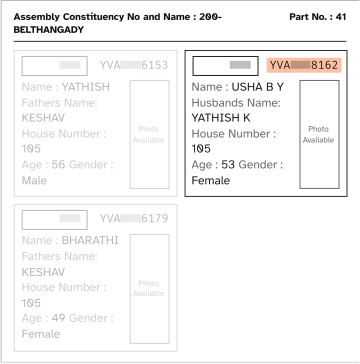
January 2025 roll, Belthangady part 41. Via Mathakaavalu. - ASDDO list
ASDDO list
Months later, her BLO’s ASDDO list marked her dead.
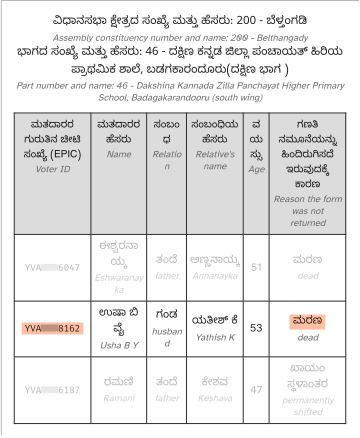
ASDDO list, Belthangady part 46, page 6. Kannada, translated in italics. - YVA0865Final roll27 Oct 2026
Final roll27 Oct 2026
After proving she’s alive, she rejoined the voter roll with her same house and husband but a new ID.
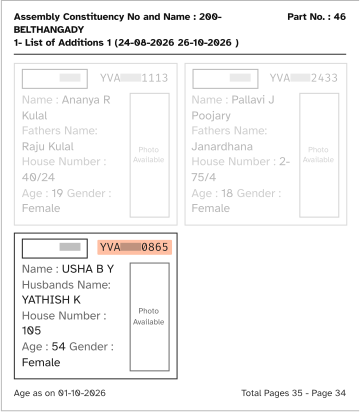
Final roll, Belthangady part 46, page 34, list of additions.
Granted this plot reminds one of the movie Om Shanti Om, but thankfully this is not very common. Of the people who were struck off as dead, 332 are back, which is the lowest rate of the four reasons.
Older voters and those marked dead were the least likely to come back
Share of voters struck off before the draft roll who are back on the final roll, by reason and age, Karnataka, October 2026
at least 332 of 16.3 lakh marked deadback on the final roll after proving they are alive
The SIR process does not appear to treat voters evenly and what happens to you varies with where you live, and possibly with which BLO you get, which electoral officer you get and how your data was entered.
Under the same rules and the same kind of form, 57 voters in Mayakonda got a notice, which is 0.03% of its voters, and only 65 in Kollegal. However, in C.V. Raman Nagar, 80,890 did, or 59% of all voters. It is not clear how such a difference can occur.
Here is the share of voters who got a notice in each constituency.
Notices were far more common in Bengaluru than anywhere else in the state
Share of voters sent a notice, by assembly constituency, Karnataka, August to October 2026
- All 28 Bengaluru constituencies sent a notice to over a quarter of their voters.
- Mayakonda sent 57 notices, to 0.03% of its voters.
What happens after the notices is just as uneven. Nine constituencies report that not one of their notices ended in a finding of ineligibility. Belgaum Uttar is one of them, with 24,368 notices and nobody found ineligible. In Hubli-Dharwad-East, 13% of the people who got a notice were struck off. In other states, this might be explained by understanding which Electoral Registration Officer you got .
Here is every constituency by how many of its voters got a notice and how many of those were then struck off.
Getting a notice was far riskier in some constituencies than in others
Share of voters sent a notice, and share of those struck off as disqualified, 219 assembly constituencies, Karnataka, October 2026
You can look up your own constituency below.
The ten constituencies that lost the most voters are all in Bengaluru
Breakdown of voter notices and disqualifications by assembly constituencies in Karnataka, January 2025 to October 2026
| Constituency | |||||
|---|---|---|---|---|---|
| Bommanahalli Bengaluru South | −53% | 46% | 4.0% | 8 | 0% |
| Dasarahalli Bangalore Urban | −50% | 33% | 0.6% | 7 | 0% |
| B.T.M Layout Bengaluru South | −50% | 39% | 1.3% | 12 | 0% |
| C.V. Raman Nagar Bengaluru North | −49% | 59% | 2.2% | 6 | 0% |
| Vijayanagar Bengaluru South | −49% | 36% | 3.0% | 10 | 0% |
| Govindarajanagar Bengaluru South | −47% | 29% | 3.0% | 7 | 0% |
| Basavanagudi Bengaluru South | −47% | 38% | 1.3% | 3 | 0% |
| Rajajinagar Bengaluru Central | −46% | 42% | 0.2% | 7 | 0% |
| Malleshwaram Bengaluru North | −46% | 37% | 1.8% | 8 | 0% |
| Gandhinagar Bengaluru Central | −45% | 34% | 0.0% | 7 | 0% |
Jaane Bhi Do Yaaro Let It Go, Friends
Now you might say, so what? Whatever your politics, there are maybe four things to consider.
First, the cost. This exercise took months of time, money and effort from citizens and administrators alike. BLOs are often school teachers working dual roles, and there have been reports of classes being disrupted and parents moving their children out of government schools because teachers were too occupied with it. Some BLOs have also died by suicide, allegedly because of the stress involved.
Second, this is the final roll, not a draft or a work in progress. Some BLOs noticed garbled names and details that seemed wrong while they were entering this data, and the ones who spoke to The Hindu said the garbled names would be fixed after the final upload. Well, this is the final upload. If there is another Special Intensive Revision twenty years from now, the duplicates, the people who were marked dead and came back, and the twins will all be part of the roll that the future voters will be asked to clarify. This roll may also soon matter for more than voting; at the end of October, Union minister Rajiv Ranjan Singh said that benefit payments now made on the basis of Aadhaar will soon be made using biometrics and voter ID numbers instead.
Third is the idea of such an asymmetry. As a voter, you are not allowed any margin of error. If you have the wrong document, if you missed a hearing, if you didn’t travel all the way back to town to present yourself, if your name is spelt differently from 2002, if your father cannot find his documents, you’re out. The institution that demands this does not meet the standard it applies to voters.
Fourth, checking any of this is harder than it should be. The Election Commission has this data, and it chooses to publish it as PDFs. Anyone who wants to verify the roll has to spend time, money and attention digitizing it first. I did some of that and Mathakaavalu did more. Verifying a public record currently depends on the goodwill of a few people with disk space and money to spare, who are willing to OCR tens of thousands of documents.
It may be added that if the petitioner so wants, he can always convert it into searchable mode which, of course, would require him to put his own efforts.
Know your constituency
- Name
- C.V. Raman Nagar
- District
- Bengaluru North
- Voters
- 1,37,623 (final roll)
- Duplicate voters
- 6.1 per 10,000 (typical 6.6)
- No valid address
- 1 in 450 (typical 1 in 30)
Karnataka SIR Final Roll, as on 27-10-2026  diagramchasing.fun
Methodology
The final roll’s count, obtained by downloading and OCRing all 60,923 Election Commission booth PDFs, was within 0.01% of the state’s official total. Mathakaavalu and Edellu Karnataka digitized older documents, including the January 2025 roll, draft roll, 2002 roll, deletions, and notices. Mistakes are possible since OCR is an automated process.
Voter IDs were used for voter tracking across lists. If someone was removed from the same constituency and reapplied (i.e., received a new ID), their name, the name of a relative, and their age were used to match them. The term “duplicates” is used to describe cards in the same booth that had different voter IDs but the same names, ages, sexes, and relatives’ names. Since rolls by themselves cannot conclusively establish identity, all duplicate counts or anomalies should be considered minimum figures.
Each example in this post was double-checked against the original PDF and a second OCR scan. Parts of voter IDs and serial numbers are hidden in the pictures, but all the links go straight to public ECI files so that they can be verified if needed.
The anonymized final roll dataset is on GitHub. Please contact us for public-interest work with the named version, although approval is not guaranteed.
We would love to do this analysis for every state where the SIR has happened, but the lack of digitalized rolls makes that very hard. Until this data becomes available in an analysable format, breakdowns for more states remain unfortunately out of reach.
Claude Opus 5.5 was used for development and analysis but not to write the reader-facing story. This website is built with Sveltekit and D3. We collect basic visitor analytics using Plausible.